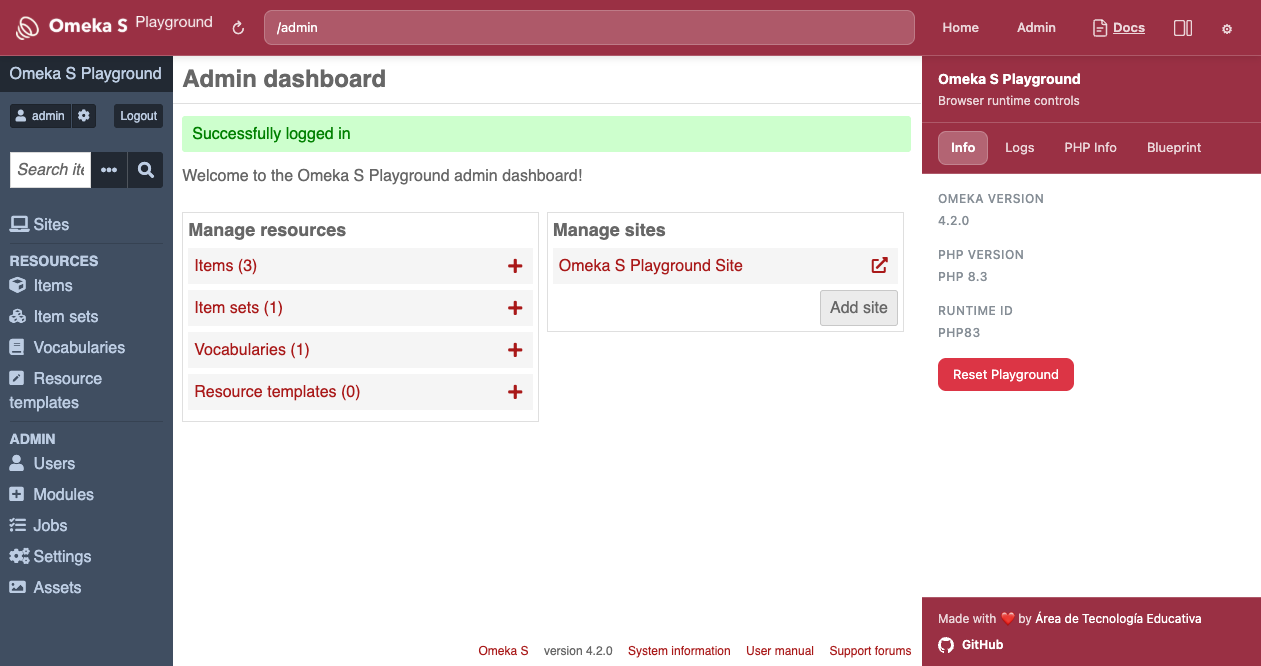
It also supports blueprint.json files, which makes it possible to preconfigure the environment, install modules, and prepare test scenarios more easily.
This may be useful for testing, workshops, onboarding, documentation examples, and quick experimentation.
It could probably be ported to Omeka Classic without too much trouble.
That said, I’m not sure it really makes sense. From what I’ve seen in forum discussions, Omeka S is usually the direction recommended for new work, while Classic tends to make more sense for older or legacy projects.
Just swinging in to say that as long time users know, different tools for different jobs. No reason to suggest that Omeka S is the default choice for all new work. There are lots of cases in which the scale and the infrastructure of Omeka Classic answers the needs of new projects.
That makes sense. Different tools fit different needs, and if Omeka Classic is still the right choice in some cases, then an Omeka Classic Playground could also be interesting.
I have not worked with Omeka Classic directly, so I do not know yet how similar the integration would be there. I also have not worked with Zend itself, though since Laminas is its evolution, I suspect it would mostly be a matter of reviewing the application-specific details.
Happy to help with that, or even to start a small prototype if there is interest.
I’m not really convinced that any of this is necessary with the Omeka S Sandbox and the Omeka.net for people to play with. I don’t think it’s something that we’d merge into the core of their platform – different uses, as you say.